Introduction
Demographics
Causes
Clinical features
Variation in skin types
Complications
Diagnosis
Differential diagnoses
Treatment
Outcome
Elastolytic giant cell granuloma is a rare granulomatous skin condition that typically occurs on sun-exposed sites, such as the face, dorsal hands, and neck. Lesions are characteristically annular (ring-shaped) plaques, although a variety of clinical presentations have been described.
It has previously also been known as annular elastolytic giant cell granuloma, actinic granuloma, or O’Brien granuloma (after the physician who first described it).
There is some debate around the nomenclature classification of this condition, including whether it is a distinct entity or a variant of granuloma annulare and whether all cases are due to light exposure.
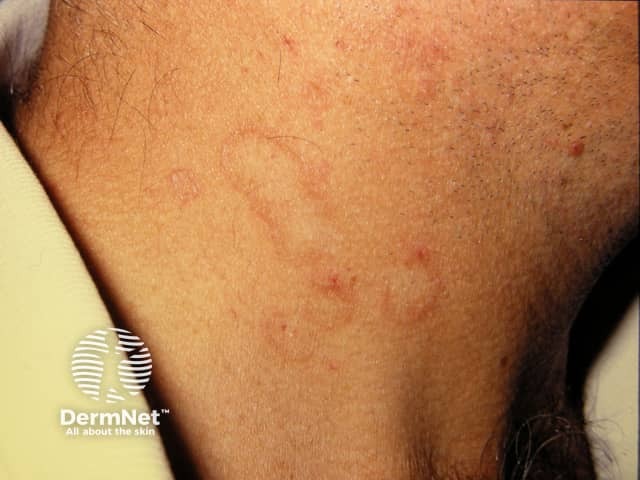
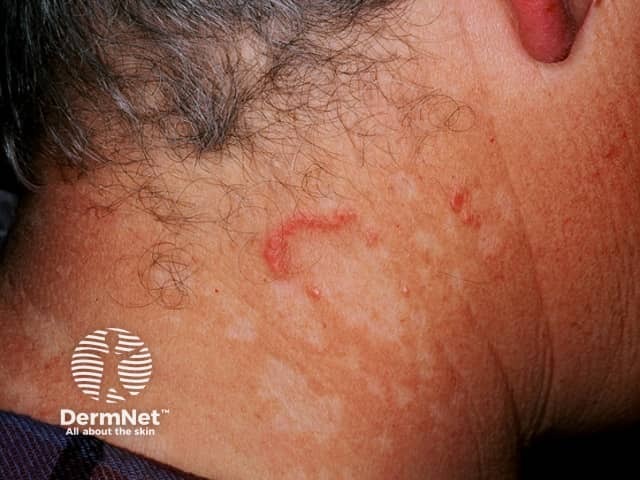
Elastolytic giant cell granuloma most commonly occurs in people aged 40–70, and those with higher levels of solar radiation exposure. There is no clear gender predominance.
The most common associated comorbidity is diabetes mellitus.
Other reported associated conditions include:
The development of elastolytic giant cell granuloma is thought to stem from a range of factors, including environmental elements such as solar radiation and heat, as well as host factors like systemic disease and malignancy. There are likely other unknown factors that contribute to its onset.
The pathophysiology of elastolytic giant cell granuloma is proposed to be an inflammatory response to changes such as sun damage, possibly to injured elastic fibres.
It is postulated that the process involves changes to the elastin antigenicity, which triggers a CD4-mediated autoinflammatory response. Dendritic cells and macrophages phagocytose elastin fragments. This leads to the formation of multinucleated giant cells or granuloma and gives rise to its characteristic histological appearance.
Human matrix metalloproteinase-12 (MMP-12), produced by macrophages, also contributes to elastin breakdown. Upregulation of MMP-12 on biopsy samples suggests its role in the elastolysis of elastolytic giant cell granuloma.
Elastolytic giant cell granuloma often begins as flesh-coloured or pink papules (small bumps) that coalesce into annular plaques (larger thickened patches).
Lesions can be single or multiple and classically have the following features:
Apart from the most common annular form, four other clinical subtypes have been described:
Although pruritus and a burning sensation have been reported, lesions are generally asymptomatic. Progression is usually slow, and lesions may spread and evolve over the course of months or years. Cases of spontaneous remission have been reported.
There is limited data regarding how elastolytic giant cell granuloma impacts varying skin types, although it has generally been reported more commonly in people with lighter skin.
This condition is benign, with an indolent course from months to years. Due to the tendency for lesions to occur in sun-exposed sites, cosmetic concern is common.
Clinical diagnosis is typically confirmed histologically on biopsy. Characteristic features show elastolysis, elastophagocytosis, and multinucleated giant cell infiltration. See: annular elastolytic giant cell granuloma pathology.
Currently, there is no internationally established treatment guideline or standard for treatment of elastolytic giant cell granuloma. Existing literature, based on retrospective analyses, points to certain therapies that may be helpful, although responses vary. There is also a risk of recurrence following cessation of therapy, even after complete clearance.
There is no significant relationship between the clinical subtype of elastolytic giant cell granuloma and the efficacy of treatment.
Elastolytic giant cell granuloma is a benign skin condition that generally lasts for years (in one study, a mean duration of 2.36 years). It can be self-limiting. Complete resolution with treatment has also been reported, although responses to treatment vary, and recurrence is common.