Skin biopsies are taken for the following reasons:
Dermatopathology is necessary to make or confirm a clinical diagnosis and determine whether margins of excision are adequate.
After a piece of skin is removed the specimen is sent ta surgical pathology (histology) laboratory. A general histopathologist or a specialist dermatopathologist examines processed routine sections under a light microscope. In some cases, special stains or other tests are required for diagnosis. A report is then issued to the referring practitioner.
Specimens of skin removed for pathological examination ideally should contain a representative sample of epidermis, dermis and subcutaneous tissue. The skin biopsy may be one of the following types: :
| Excision biopsy | A skin lesion is completely cut out for diagnosis and treatment |
| Incisional biopsy | A segment of the lesion is removed for diagnosis only |
| Shave / tangential biopsy | A horizontal section of the skin is removed for diagnosis or treatment |
| Punch biopsy | A standard round specimen 2-6 mm in diameter for diagnosis |
| Currettings | Fragments of tissue are removed using a ring or spoon curette for treatment |
| Fine Needle Aspiration | A needle is inserted into the lesion and cells are aspirated for direct examination. |
The sample should be transported in fixative (usually 10% neutral buffered formalin); the volume should be at least ten times that of the tissue. Make sure the pot is properly sealed. Label it with the patient's full name and a second identifier (date of birth and/or National Health Index number), the site of the biopsy and the date.
A request form should accompany specimens to the pathology laboratory. The form should include patient details including age and sex, a description of the specimen type, the exact site of the biopsy, and clinical details including as a minimum the suspected diagnosis, differential diagnosis and brief clinical history, including duration of the lesion and any treatment applied.
The purpose of fixation is to preserve the skin specimen indefinitely in a life-like state. For normal histological sections, the specimen of skin is immediately placed in formol saline (formalin). It remains in this preservative for a minimum of 24 hours prior to processing by a histotechnologist.
Formalin fixes the tissue by forming cross-links between lysine residues in the proteins, which does not alter their structure. It is buffered with phosphate to prevent acidity provoked by tissue hypoxia, maintaining a pH of 7. It penetrates effectively into the tissue but rather slowly, depending on its thickness; tissues can be fixed faster if they are warmed.
If no fixative is available at the time of biopsy, the specimen should be kept moist with saline and transported to the laboratory as soon as possible; contact the lab in advance to confirm that there will be someone available to receive it.
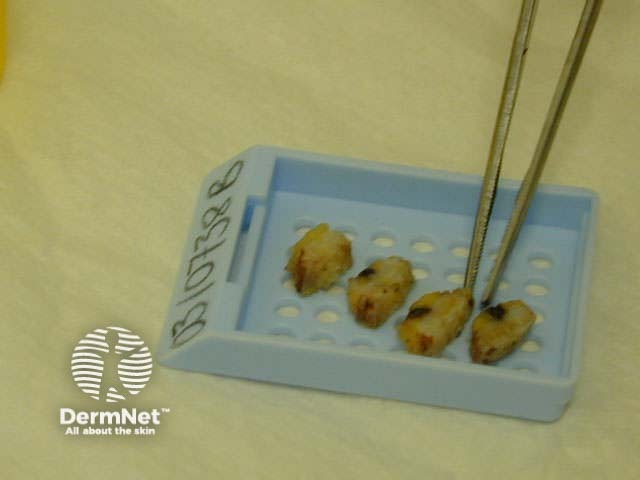
The technologist assigns the specimen a unique accession number, examines it and describes the gross appearance of the specimen. If malignancy is suspected, the edges of the specimen may be marked with ink to identify excision margins. All or parts of the specimen are placed into one or more small plastic cassettes which hold and identify the tissue while it is being processed, and which acts as the backing for the final paraffin block. Initially, the cassettes are placed into a fixative.
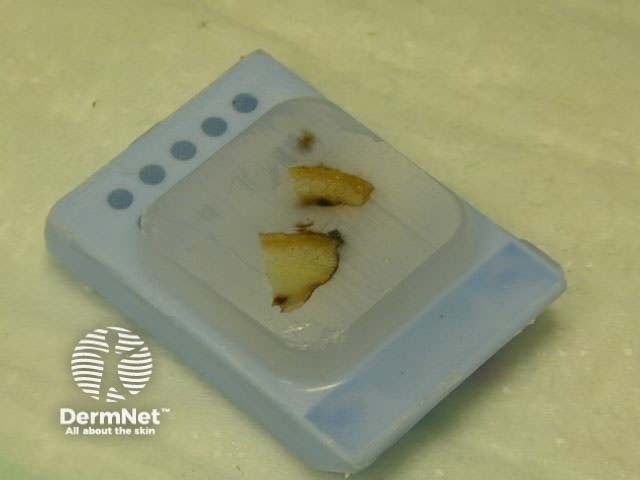
Paraffin blocks are then prepared to allow the tissue to be cut into thin microscopic sections (3–5 microns). Using an automated processor, the water is removed from the tissue by alcohol dehydration. The alcohol is cleared using xylene and then the tissue is ready to be embedded in paraffin wax. The technician removes the tissue from its cassette, aligns it carefully in a mould and pours hot paraffin wax over it. As the wax cools, it solidifies to form the block ready for sectioning.
Large laboratories may use a microwave processing machine when tissue needs to be processed rapidly, eg, within 2 hours, but these are not generally available.
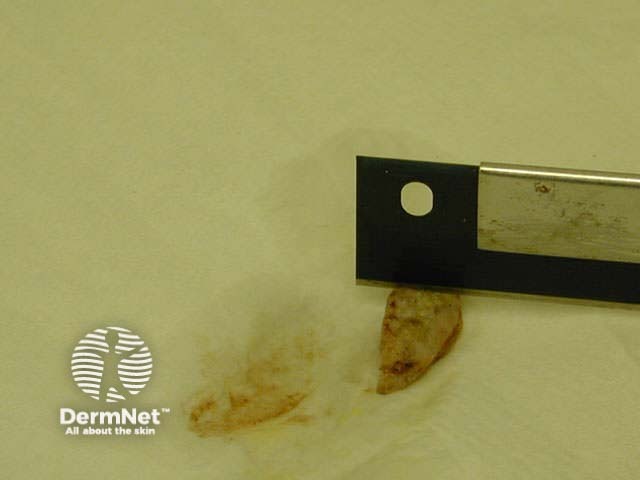
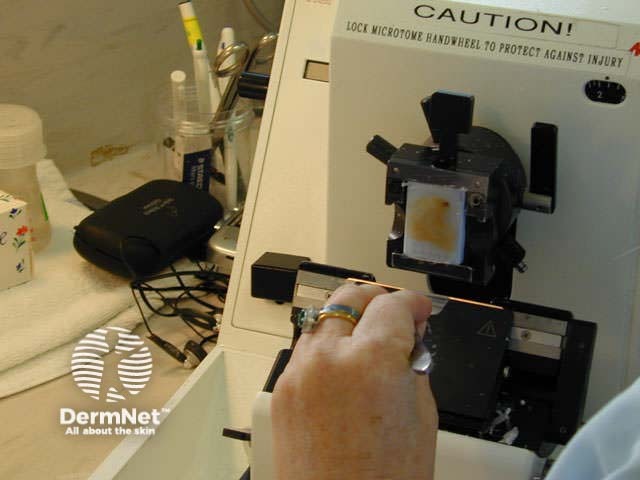
The embedded tissue is cut into sections using a microtome, which moves the block across a very sharp knife every 3 to 5 microns. The sections are then floated on a warm water bath, picked up on a glass microscope slide and dried in a warm oven.
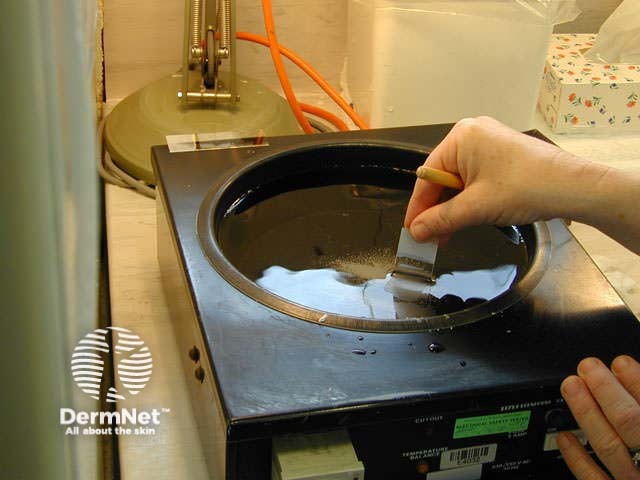
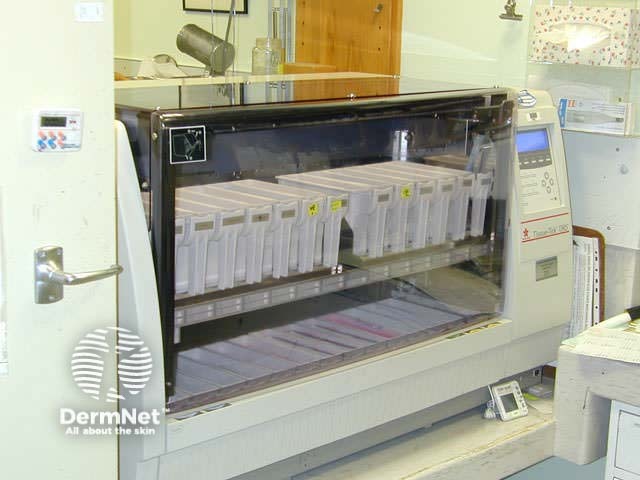
By another automated process, the paraffin is removed from the sections by sequentially immersing in xylene, then alcohol and then water. The slide is then stained routinely using haematoxylin and eosin (H and E). This is an automated process in larger laboratories, but some centres stain manually. In some situations, other special stains may be used.
The stained slide is processed again through water, alcohol and xylene. A resin is applied to glue a coverslip or plastic film in place over the section. The slide is now ready for the pathologist to examine and report the microscopic description, the diagnosis and comments.
If the tissue is not processed carefully, various artefacts may be present on the slide.
| Fine black spots | Formalin-haem pigment if the formalin used is too acidic (unbuffered). |
| Holes | Tearing by microtome because of insufficient tissue dehydration or the presence of hard material such as calcium or sutures. |
| Bubbles | Mounting media to thin or contaminated clearing agents. |
| Carryover artefacts and floaters | Tissue from another specimen is carried over on the sectioning knife or has dropped onto the slide in the water bath because of inadequately cleaning between cases |
Mislabelling specimens or lack of labelling is another potential error, although blocks are usually routinely given two means of identification (eg, name and lab number) to prevent this.
Arrange to visit your local medical laboratory and ask to be shown the techniques described above.