Introduction
Causes
The hair growth cycle
Hair miniaturisation
Role of DHT
Role of 5-alpha-reductase
Role of heredity and genetics
Prevalence
A cosmetic issue?
Treatment
Male pattern hair loss is the most common type of diffuse thinning of the hair and balding that occurs in adult males.
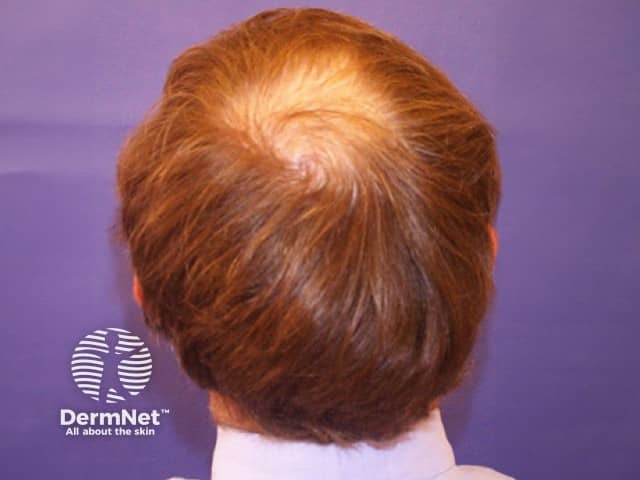
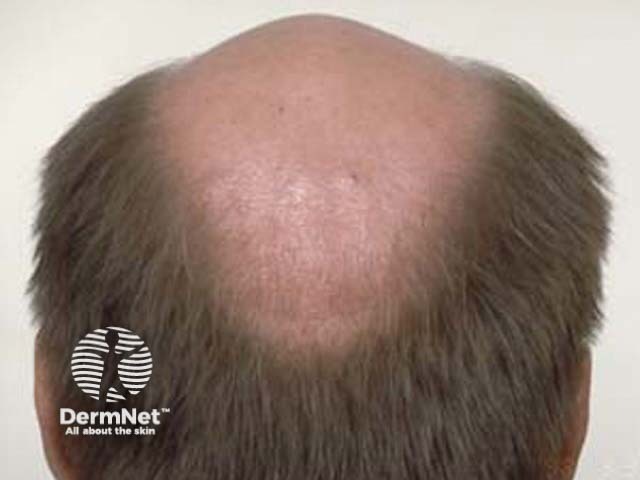
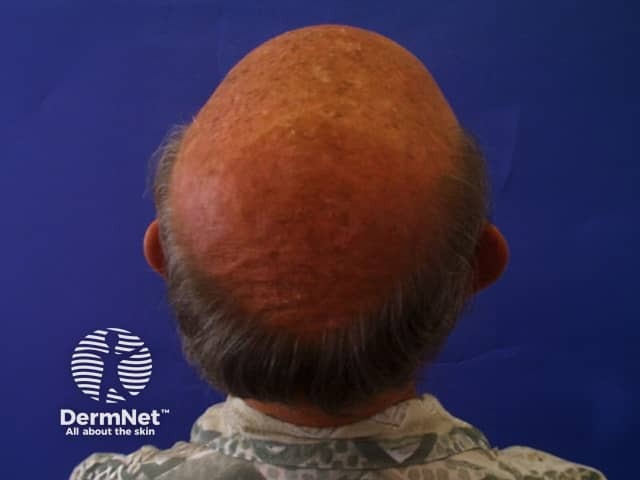
Male pattern hair loss is an inherited condition, caused by a genetically determined sensitivity to the effects of dihydrotestosterone (DHT) in some areas of the scalp. DHT is believed to shorten the growth, or anagen, phase of the hair cycle, from a usual duration of 3–6 years to just weeks or months. This occurs together with miniaturisation of the follicles and progressively produces fewer and finer hairs. The production of DHT is regulated by an enzyme called 5-alpha reductase.
Several genes are involved, accounting for differing age of onset, progression, pattern and severity of hair loss in family members. The susceptibility genes are inherited from both mother and father. At this time, genetic testing for prediction of balding is unreliable.
A few women present with male pattern hair loss because they have excessive levels of androgens as well as genetic predisposition. These women also tend to suffer from acne, irregular menses and excessive facial and body hair. These symptoms are characteristic of polycystic ovarian syndrome (PCOS) although the majority of women with PCOS do not experience hair loss. Less often, congenital adrenal hyperplasia may be responsible. Females that are losing their hair with age are more likely to present with female pattern hair loss, in which hormone tests are normal.
All hair follicles are replaced at different rates by the normal process of hair cycling. Hair growth alternates between phases of activity and rest. The growth period, called the anagen phase, lasts for two to six years. During this time, the follicle is long and deep and produces thick, well-pigmented hair. About 90% of all scalp hairs are in the anagen phase at a given time.
Anagen is followed by a brief transition phase known as the catagen phase, which lasts 1–2 weeks. During this time, the base of the follicle shrivels. The resting period, or telogen phase, follows catagen and lasts for three months. In this phase, the shrunken follicle retains the hair fibre. Following the telogen phase, the next anagen phase begins, and the old hair is dislodged and falls out to make room for new hair to begin growing in its place.
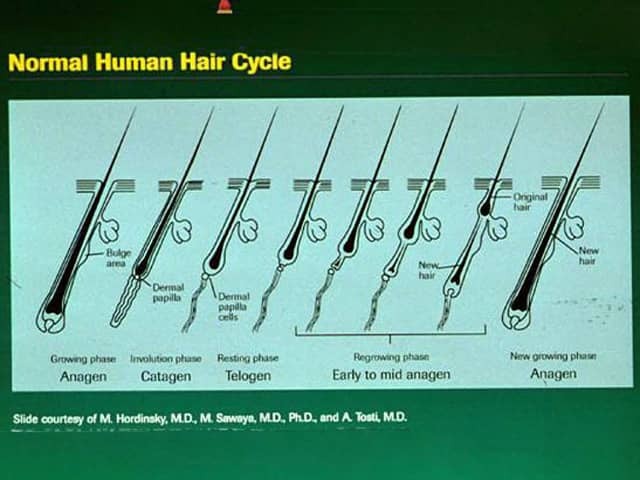
Image © 1998 Merck Sharpe and Dohme (with permission)
Unlike other areas of the body, hairs on the scalp to grow in tufts of 3–4. In androgenetic alopecia, the tufts progressively lose hairs. Eventually, when all the hairs in the tuft are gone, bald scalp appears between the hairs.
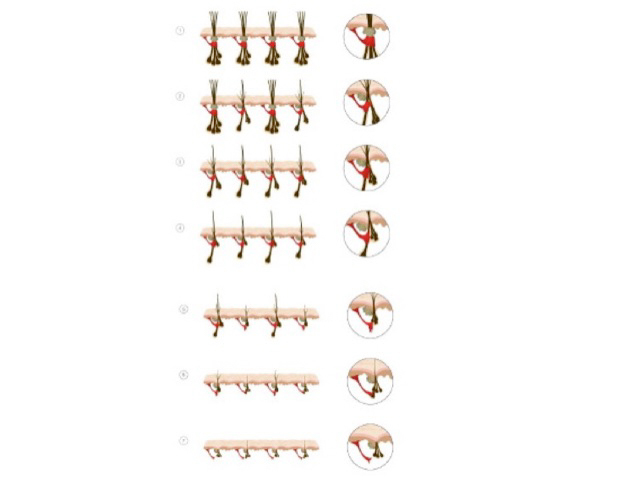
Image courtesy of R. Sinclair, FACD
DHT is found in several tissues in the body including the prostate gland and skin.
5-alpha reductase is an enzyme that regulates the production of DHT. An enzyme is a protein that acts as a catalyst to speed up a chemical reaction. 5-alpha reductase can be inhibited by specially synthesised drugs (see below).
Male pattern hair loss occurs in men who are genetically predisposed to be more sensitive to the effects of DHT. Researchers now believe that the condition can be inherited from either side of the family.
Male pattern hair loss affects nearly all men at some point in their lives. It affects different populations at different rates, probably because of genetics. Up to half of male Caucasians will experience some degree of hair loss by age 50, and possibly as many as 80% by the age of 70 years, while other population groups such as Japanese and Chinese men are far less affected.
The severity of hair loss can be classified in several ways. Norwood and Sinclair systems are shown below.
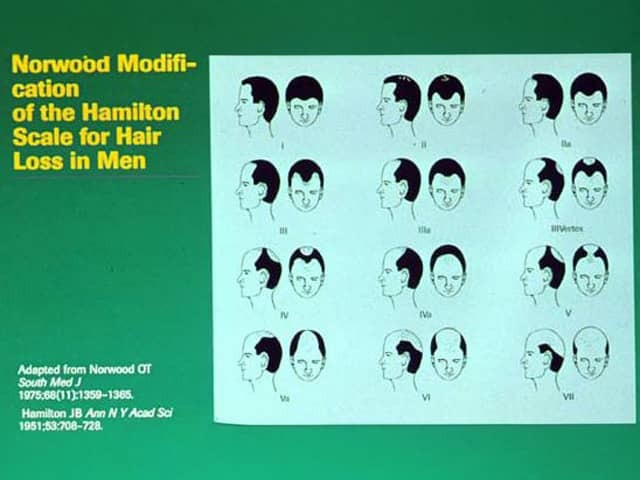
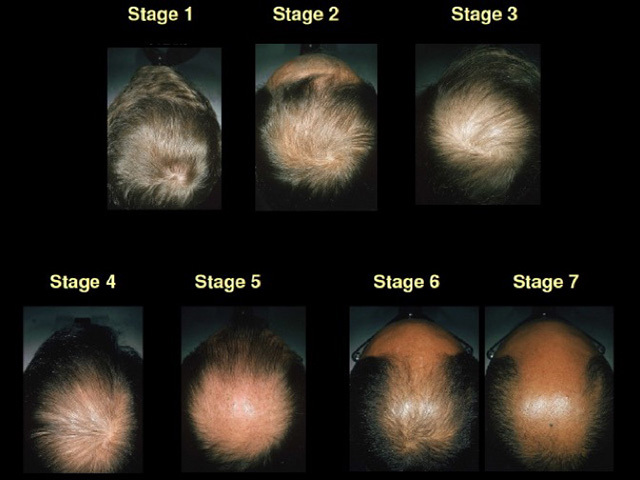
* Image © 1998 Merck Sharpe and Dohme, with permission.
° Images courtesy of R. Sinclair, FACD
Male pattern hair loss can have a negative psychological impact. Studies have shown that hair loss can be associated with low self-esteem, depression, introversion, and feelings of unattractiveness. This is reinforced by attitudes in Western society, which place great value on youthful appearance and attractiveness. Some studies have shown that based on appearance alone, men with hair loss are seen as less attractive, less assertive, less likeable, and less successful than men without hair loss.
Current treatment options include:
Clascoterone, a topical androgen receptor antagonist, is under investigation as a treatment option.
There is some evidence that ketoconazole shampoo may also be of benefit, perhaps because it is effective in seborrhoeic dermatitis and dandruff. Low-dose oral minoxidil (off label) can increase hair growth on the scalp, but may also result in generalised hypertrichosis and other adverse effects [1].
Low-level laser therapy is of unproven benefit in pattern balding; one device has been approved by the FDA for marketing. Platelet-rich plasma injections are also under investigation. Further studies are required to determine the magnitude of the benefit if any.
Jimenez-Cauhe J, Saceda-Corralo D, Rodrigues-Barata R, Hermosa-Gelbard A, Moreno-Arrones OM, Fernandez-Nieto D, Vaño-Galvan S. Effectiveness and safety of low-dose oral minoxidil in male androgenetic alopecia. J Am Acad Dermatol. 2019 May 2. pii: S0190-9622(19)30685-1. doi: 10.1016/j.jaad.2019.04.054. [Epub ahead of print] PubMed PMID: 31054970.
Nohria A, Desai D, Sikora M, et al. Treatment of androgenetic alopecia with low-dose oral minoxidil monotherapy compared with combination therapy with dutasteride or finasteride. J Am Acad Dermatol. 2025;92(5):1159-1161. Journal