Food allergy
What is food allergy?
Food allergy refers to a reaction to a food protein that is either immediate (occuring seconds to minutes after eating or touching the food item) or delayed (occurring hours or days later). True allergy may occur when the affected person eats or touches a tiny amount of the responsible protein.
Food allergy is most common in young babies (4%), who often outgrow their allergies. About 2% of adults also suffer from allergy to one or more foods. The tendency to food allergy runs in families.
Food allergy and the skin
Skin conditions due to food allergy include:
- Some cases of anaphylaxis: serious reaction with urticarial rash, difficulty breathing and circulatory collapse.
- Some cases of acute urticaria: hive reaction occuring soon after eating the responsible food.
- Some cases of contact urticaria: swelling and redness confined to the area touching the food.
- Mucosal contact urticaria: short-lasting irritation and swelling confined to mucosal surfaces, particularly mouth and lips.
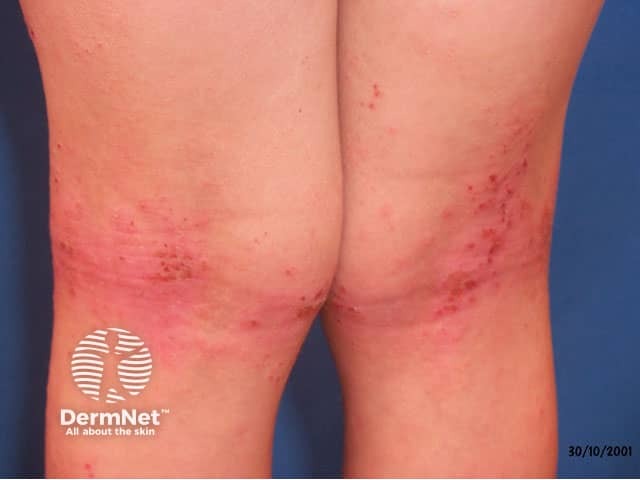
- Some cases of atopic eczema: exacerbations of eczema after eating certain foods.
- Some cases of allergic contact dermatitis: touching a food such as fig results in dermatitis in areas in contact with it.
- Some cases of photoallergic contact dermatitis: touching a food results in dermatitis in areas in contact with it and then exposed to the sun.
- Protein contact dermatitis: contact urticaria followed by dermatitis.
- Some aphthous ulcers, e.g., due to chocolate or mint allergy
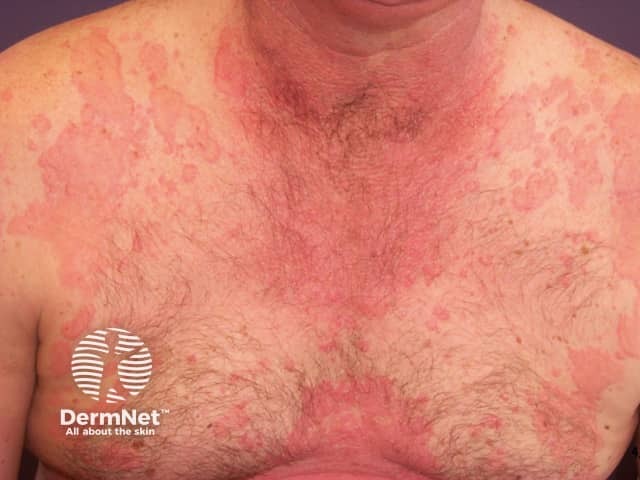
- Dermatitis herpetiformis (gluten): an uncommon blistering rash associated with celiac disease.
|
Atopic eczema |
Dermatitis herpetiformis |
Other symptoms from food allergy
Food allergy may result in the following symptoms:
| Respiratory allergy |
|
| Gastrointestinal allergy |
|
| Circulatory allergy |
|
What foods cause allergic reactions?
About 90% of allergic reactions are due to the following food items:
- Egg
- Milk
- Peanut
- Soy
- Fish
- Seafod
- Wheat
- Tree nuts
There are numerous other foods and plants that occasionally cause allergy. Some are listed here.
- Seeds
- Kiwifruit
- Corn and maize
- Lupin
- Mango
- Legumes (chickpeas, beans, peas, lentils)
- Spices such as balsam of Peru
Allergy may also be provoked by preservatives such as parabens, and flavouring agents such as garlic and fragrances in foods.
How is food allergy diagnosed?
Food allergy is diagnosed by taking a careful history of the symptoms and their relationship to food, supported by examination findings and the results of tests. Unfortunately, neither history nor tests are entirely reliable in everyone.
- A false positive means the test was positive but the patient is not allergic to the test substance.
- A false negative means the test was negative but the patient is allergic to the test substance.
The main tests for food allergy are:
- Prick tests
- Specific IgE blood tests (RAST)
- Patch tests, in some cases of dermatitis
- Skin biopsy and antigliadin / antiendomysial blood test for dermatitis herpetiformis
Food intolerance
Not all reactions to food are due to true allergy. Intolerance can cause similar symptoms to allergy, including urticaria and dermatitis. But the reaction often depends on how much is consumed. These reactions are classified as follows.
- Allergy-like intolerance i.e., symptoms consistently arise from a specific food but tests are negative.
- Phototoxic contact dermatitis to a plant such as lime or parsley.
- Irritants, e.g., irritant hand dermatitis due to handling vegetables and fruit; stinging from acidic compounds.
- Chemical intolerance e.g., urticaria induced by salicylates and amines.
- Food toxins, e.g., urticaria in scombroid fish poisoning.
- Enzyme deficiency, e.g., porphyria cutanea tarda induced by alcoho; flushing from alcohol.
- Excessive ingestion, e.g., carotenaemia from excessive intake of yellow or red-coloured foods.
- Heavy metal toxicity from contaminants in food, e.g., mercury found in longlived fish.
Food deficiencies
Skin conditions may also be due to deficiencies in the diet, sometimes because of attempts to reduce exposure to known or presumed allergens.
- Protein / calory malnutrition: kwashiorkor
- Vitamin B deficiency: pellagra
- Vitamin C deficiency: scurvy
- Vitamin D deficiency
- Zinc deficiency: acrodermatitis enteropathica
- Iron deficiency
- Biotin deficiency
Treatment
The mainstay of management is to identify which foods are responsible for reactions, and then to avoid them. Prescribed treatments depend on symptoms, and may include:
- Adrenaline injections for emergencies in case of anaphylaxis
- Antihistamines for urticaria and rhinitis
- Topical steroids for eczema
- Nasal sprays for rhinitis and inhalers for asthma
- Dapsone for dermatitis herpetiformis
Draft 29 November 2008
Related information
References:
- Eating safely when you have food allergies – New Zealand Food Safety Authority PDF document
On DermNet NZ:
Other websites:
Books about skin diseases:
See the DermNet NZ bookstore