Introduction Effects Causes Clinical features Diagnosis Treatment
Psoriasis is a chronic inflammatory skin disease in which there are clearly defined, red, scaly plaques (thickened skin). There are various subtypes of psoriasis.
Psoriasis is linked to other health conditions, including inflammatory arthritis, inflammatory bowel disease (especially Crohn disease), uveitis and coeliac disease.
Psoriasis may be localised to the palms and soles or part of generalised chronic plaque psoriasis. Two common patterns are observed:
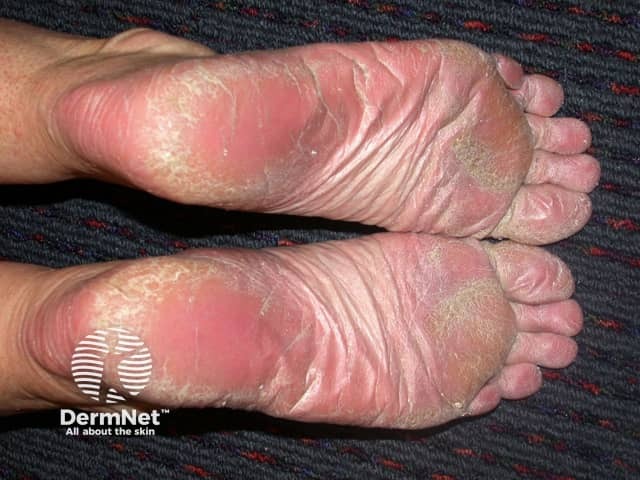
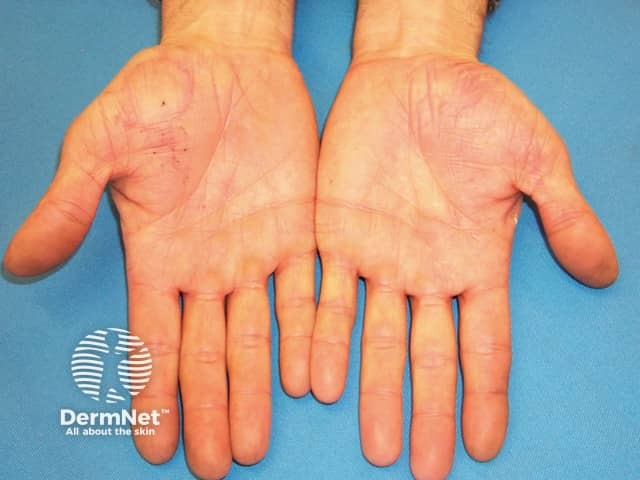
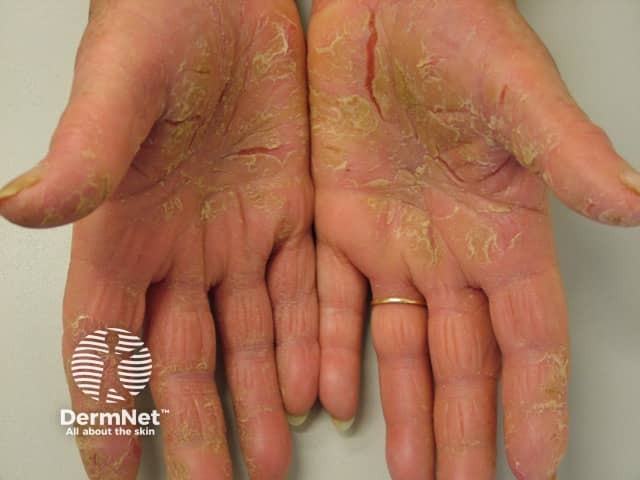
See more images of palmoplantar psoriasis.
Palmoplantar pustulosis and the rare acrodermatitis continua of Hallopeau (acral pustulosis), in which yellow-brown pustules occur, are no longer classified as psoriasis. However, the conditions are associated. About 10–25% of people with palmoplantar pustulosis also have chronic plaque psoriasis.
The tendency to psoriasis is inherited, but what causes it to localise on the palms and soles is unknown. It may be triggered by an injury to the skin, an infection, or another skin condition such as hand dermatitis. It may first occur during a period of psychosocial stress. Certain medications, particularly lithium, may be associated with the onset of flares of psoriasis.
Psoriasis is more common, often more severe, and sometimes difficult to treat in patients that are obese, have metabolic syndrome, that drink excessive alcohol or smoke tobacco.
Palms and soles affected by psoriasis tend to be partially or completely red, dry and thickened, often with deep painful cracks (fissures). The skin changes tend to have a sharp border and are often symmetrical, ie similar distribution on both palms and/or both soles. At times, palmar psoriasis can be quite hard to differentiate from hand dermatitis and other forms of acquired keratoderma. Plantar psoriasis may sometimes be similar in appearance to tinea pedis. There may be signs of psoriasis elsewhere.
Palmoplantar psoriasis tends to be a chronic condition, ie, it is very persistent.
Compared to chronic plaque psoriasis on other sites, palmoplantar psoriasis is more commonly associated with:
Palmoplantar psoriasis is diagnosed by its clinical appearance, supported by finding chronic plaque psoriasis in other sites. Mycology of skin scrapings may be performed to exclude fungal infection. Skin biopsy is rarely needed.
The differential diagnosis of palmoplantar psoriasis includes:
Improvement in general health can lead to an improvement in palmoplantar psoriasis.
Mild psoriasis of the palms and soles may be treated with topical treatments:
Calcipotriol ointment is not very successful for palmoplantar psoriasis. It may also cause an irritant contact dermatitis on the face if a treated area inadvertently touches it. Dithranol is too messy and irritating for routine use on hands and feet.
More severe palmoplantar psoriasis usually requires phototherapy or systemic agents, most often:
Biologics (targeted therapies) are also sometimes prescribed for severe palmoplantar psoriasis. However, it should be noted that TNF-alpha inhibitors such as infliximab and adalimumab may trigger palmoplantar pustulosis.