Introduction Demographics Clinical features Diagnosis Causes Treatment
Granular parakeratosis is an uncommon red and scaly skin condition that mainly affects body folds, most often the armpits. It has a characteristic appearance under the microscope.
It is also called hyperkeratotic flexural erythema and may be the same condition as recurrent flexural pellagroid dermatitis [1].
Granular parakeratosis is often reported in middle-aged women but has been reported to affect babies, children and men of all races.
Granular parakeratosis can present as an intertrigo (rash in body folds) or as a non-intertriginous rash. It presents as a red or brown patchy scaly rash, most often in the armpits or in other skin folds. It is sometimes itchy. In severe cases, the rash spreads widely over the trunk. As it heals, the skin peels off (desquamation), resembling the peeling seen in pellagra.

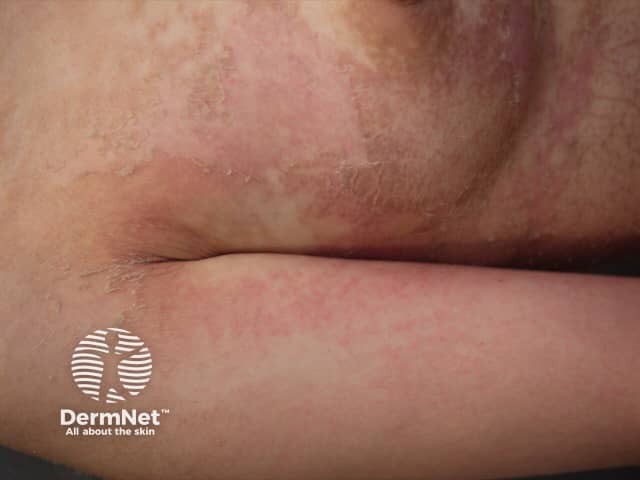
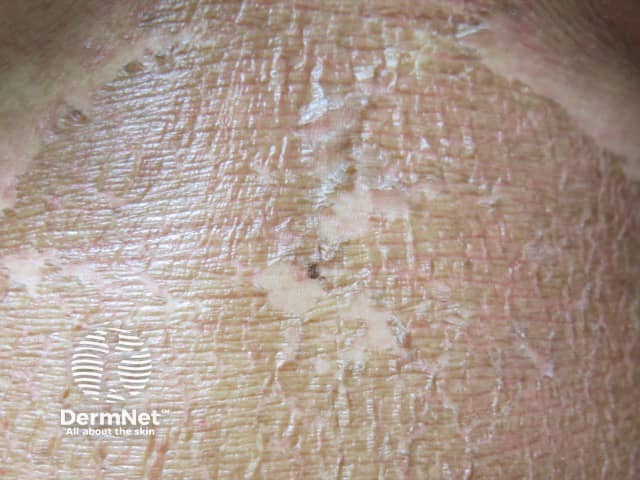
See more images of granular parakeratosis.
Granular parakeratosis is diagnosed by skin biopsy. There is a distinctive reaction pattern on histopathology (parakeratosis, hypergranulosis (hence its name), acanthosis, papillomatosis and prominent blood vessels).
The affected areas should be swabbed and any pathogen treated with antibiotics.
Patch testing may be helpful in identifying a contact allergen.
Granular parakeratosis is thought to be provoked by friction, occlusion, and sweating.
A defect in filaggrin production may predispose to granular parakeratosis. This protein is normally present in the upper epidermis, but there are various genetic variants that lead to a weakness of the skin's barrier function. These include a common cause of dry skin, ichthyosis vulgaris.
Cosmetic or laundry products containing the antiseptic, benzalkonium chloride, may be responsible for some cases. Acting as a surfactant, benzalkonium chloride may disrupt cellular lipid membranes and inactivate enzymes within the skin, inducing proliferation, abnormal development of the skin cells (keratinocytes), and irritant contact dermatitis. Recurrent flexural pellagroid dermatitis [1] was reported to be an irritant contact dermatitis to the anionic surfactant, sodium lauryl sulphate (SLS), in soapless cleansing bars.
This may induce proliferation and abnormal development of the skin cells (keratinocytes).
Changes in the skin microbiota have also been blamed.
Granular parakeratosis may resolve by itself. If due to a specific contact factor, it will settle down within a few weeks of recognising and avoiding it.
Treatments that have been reported to be useful include: