logo

DermNet NZ

Advertisement

Facts about skin from the New Zealand Dermatological Society Incorporated. Topic index: A B C D E F G H I J K L M N O P Q R S T U V W X Y Z

McCune-Albright syndrome

Background

McCune-Albright syndrome (MAS) is a rare condition that was first described in 1937. It is sometimes called Albright syndrome.

The classic triad consists of 3 features:

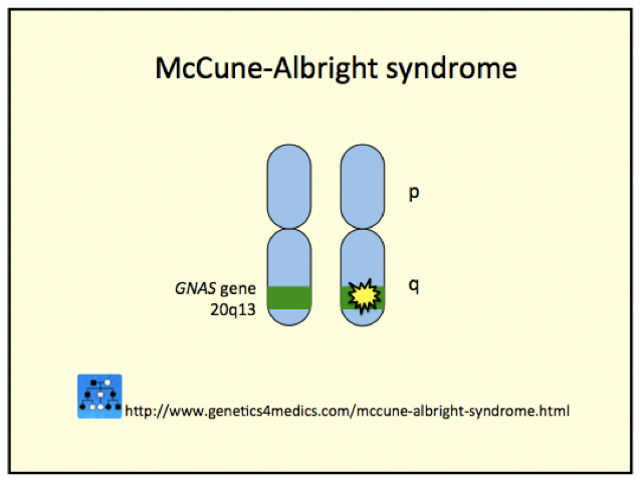
At least 2 of these features need to be present to diagnose the condition. MAS is caused by a spontaneous (chance) mutation in the GNAS1 gene. This gene then forms an abnormal protein that regulates cell proliferation, migration and survival. The mutation occurs early in the development of an embryo and affects only a subset of the patient's cells (called mosaicism). The mutation cannot be passed on to affected patient's children.

Clinical features

1. Patchy skin pigmentation
  • Seen in approximately 60% of patients,
  • Often the first sign of this disorder as present at birth or noted during the first few months of life.
  • Distinct shape and distribution: often large (segmental) and with jagged borders (unlike the smaller café-au-lait macules (CALM) with smooth borders seen in neurofibromatosis), rarely extend over the midline and most are on the side overlying the bone defects.
  • May follow the lines of Blaschko.
2. Bone abnormalities
  • Fibrous dysplasia of bones (polyostotic fibrous dysplasia); normal bone is replaced by fibrous tissue and weakened bone.
  • Usually develop during the first ten years of life, and progress until early adulthood and then become relatively stable..
  • The femur (long leg bone) and pelvis (hip bone) are the most common bones involved, and X-rays show lytic lesions with scalloped borders and a “ground glass” pattern.
  • May cause recurrent fractures, bone pain, facial asymmetry, scoliosis (abnormal curvature of the spine), unequal leg length, limb bowing, or a limp.
3. Endocrine abnormalities
  • These are characterised by overactive hormones.
  • The most common endocrine abnormality in MAS is early puberty; the average age of onset is around 5 years. Girls are more commonly affected than boys.
  • Early puberty in girls is due to high levels of oestradiol produced by ovarian tissue.
  • MAS is also associated with hyperthyroidism, growth hormone excess (acromegaly), Cushing syndrome, breast discharge due to excess prolactin hormone, and renal phosphate wasting (excess urinary excretion of phosphate, which may result low circulating phosphate in the blood).
4. Other associated problems MAS has been associated with a variety of other clinical problems including:
  • Developmental delay
  • Liver disease and jaundice
  • High blood pressure and abnormal heart rhythms

Diagnosis

Treatment

Complications

Related information

References:

On DermNet NZ:

Other websites:

Books about skin diseases:

See the DermNet NZ bookstore

Author: Dr Marie Hartley, Staff Writer.

DermNet does not provide an on-line consultation service.
If you have any concerns with your skin or its treatment, see a dermatologist for advice.