Introduction
Demographics
Causes
Clinical features
Complications
Diagnosis
Differential diagnosis
Treatment
Prevention
Outcome
Notalgia paraesthetica is a chronic neuropathic dysesthesia characterised by pruritus and/or changed sensation in areas of skin over the medial aspect of the shoulder blade on either side of the back. There is often a hyperpigmented patch over the affected area.
It is a form of cutaneous dysaesthesia and is also known as thoracic cutaneous nerve entrapment syndrome.
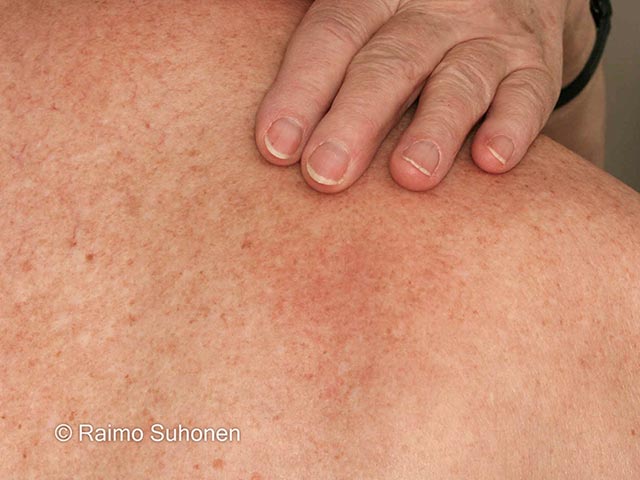
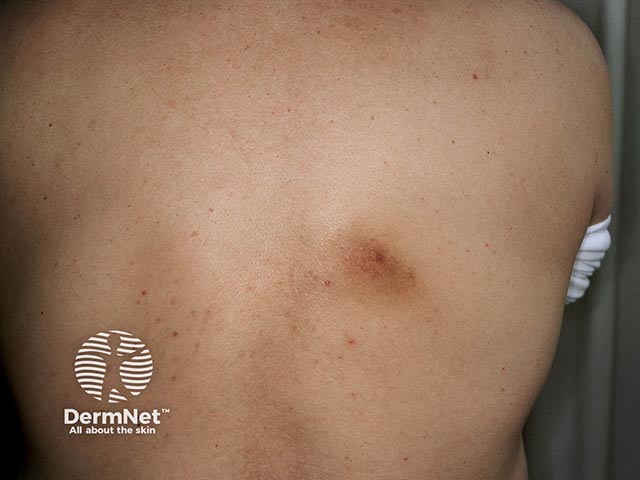
Notalgia paraesthetica can affect anyone but is typically seen in older females. It affects roughly 10% of the adult population.
Notalgia paraesthetica results from injury to the nerves that supply the skin of the affected areas. These nerves originate from the 2nd to 6th thoracic segments of the upper spinal cord and travel through the thick back muscles before making a right-angled turn to reach the skin. These nerves are particularly vulnerable to compression or traction at various points along their path which leads to symptoms of notalgia paraesthetica.
The initial nerve injury may occur due to factors such as:
Notalgia paraesthetica is characterised by intense itch, typically localised to the area between or below either shoulder blade. This itch can be intermittent or continuous.
It can also be accompanied by tenderness, burning pain, or change in sensation in the affected skin area. There may be reduced or absent sweating in the affected area. The affected area may spread to both shoulder blades and more widely over the back and shoulders. In many patients, there are no visible signs.
Visible skin changes are usually the result of repeated scratching or rubbing and include:
Complications of notalgia paraesthetica may include:
Notalgia paraesthetica is typically diagnosed based on clinical evaluation.
If the examination suggests possible musculoskeletal or neurological issues, further investigation with imaging studies (eg, X-rays, CT, or MRI scans) may be warranted. Imaging may demonstrate a degenerative vertebra or prolapsed disc in the area that corresponds to the nerve supply to the affected skin (the dermatome).
Differential diagnoses for notalgia paraesthetica include:
There is no cure for notalgia paraesthetica, however treatment options are available to provide symptomatic relief. It is important to reassure patients that this condition is benign.
Typical management may include the following:
Physical therapy with repetitive exercises and stretches for the upper back has been reported to be effective.
Preventing notalgia paraesthesia can be challenging since its development is often linked to factors like nerve compression or irritation which may not always be easily avoidable.
However, certain preventative measures can help reduce the risk such as maintaining good posture and avoiding repetitive strain.
Notalgia paraesthetica typically follows a chronic course. The extent of the itch can range from mild to significantly debilitating in patients. While it generally does not resolve completely, it can be managed and, in some cases, may go into complete remission.