Schnitzler syndrome is the association of:
Schnitzler syndrome is rare. It was named after a French dermatologist, Dr Liliane Schnitzler, who described the condition in 1972.
The cause of Schnitzler syndrome is unknown. Alterations in the cytokine network have been reported. Interleukin 1 alpha binding activity has been described in some patients with Schnitzler syndrome. Interleukin 1 alpha is a cytokine or inflammatory mediator and could explain some of the inflammatory symptoms of the syndrome. A few patients have been described with a mutation in the gene NLRP3.
Patients with Schnitzler syndrome may present to dermatologists, haematologists, rheumatologists and general physicians because of the variety of possible symptoms. The diagnosis is often delayed.
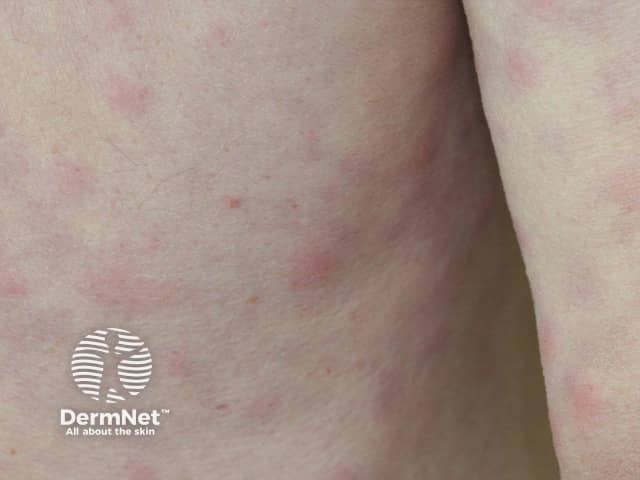
Urticaria (hives) describes red raised patches of skin. These are rarely itchy in Schnitzler syndrome, unlike ordinary urticaria. Weals may last longer than ordinary urticaria, often persisting for 12 hours to 3 days. A skin biopsy may or may not show features of urticarial vasculitis. Angioedema (deep swelling) may also occur in some patients.
Skin biopsy may show a neutrophil-rich infiltrate.
Painful joints (arthralgia) or swollen joints (arthritis) occur in 80% of patients. Some patients experience bone pain.
Intermittent fever up to 40C affects 90% of patients with Schnitzler syndrome. The fever may be accompanied by chills and night sweating.
Organomegaly refers to enlarged internal organs, i.e., large lymph nodes (lymphadenopathy) in 40% of patients, and enlarged liver and spleen (hepatosplenomagaly) in 30%.
The main haematological (blood) abnormality of Schnitzler syndrome is monoclonal gammopathy. This usually means a raised level of immunoglobulin M (IgM) but raised immunoglobulin G (IgG) or combinations of IgM and IgA or IgM and IgG have also been reported. Bone marrow tests are normal in 80% at the time of diagnosis.
Other haematological abnormalities in Schnitzler syndrome may include:
Schnitzler syndrome is a chronic condition, and it has not been reported to resolve. Although symptoms can be a nuisance, the condition does not lead to serious disease in the majority of patients. However about 15% of patients progress to a lymphoproliferative disorder such as Waldenström macroglobulinemia or B-cell lymphoma. In Schnitzler's original case the patient died aged 88 years with diffuse “lymphoplasmacytic malignancy” after 20 years of follow up.
Long term review by a specialist is recommended.
Anakinra is an effective treatment for Schnitzler syndrome. It is an interleukin 1 antagonist, registered to treat rheumatoid arthritis (not yet subsidised for autoinflammatory diseases in New Zealand [2015]). In Schnitzler syndrome, anakinra 100 mg/day allows a complete control of all symptoms including:
Complete remissions have been reported in at least 10 patients with anakinra at a daily subcutaneous dose of 100 mg. Some patients have experienced a recurrence of signs and symptoms within 1 day of stopping treatment; anakinra must be given on a continuous basis. Localised painful erythematous injection site reactions may occur.
Other IL-1 antagonists are under investigation for the treatment of Schnitzler syndrome, including rilonacept and canakinumab. IL-6 anatoganists have been tried for non-responders to IL-1 responders.
The following treatments have also been tried for Schnitzler syndrome with varying success:
Schnitzler syndrome is a chronic disease so discontinuing an effective treatment can be expected to lead to relapse of the disease.