Introduction
Demographics
Causes
Clinical features
Variation in skin types
Complications
Diagnosis
Differential diagnoses
Treatment
Outcome
Dyshidrotic eczema (pompholyx) is an itchy, chronic, recurrent, often symmetric eruption on the palms of hands, fingers, and soles of the feet. It is characterised by small, deep-seated, 1–2 mm fluid-filled vesicles on these sites, which resolve after several weeks with scaling.
Debate exists around precise terminology and definitions but other names for this condition include pompholyx, acute and recurrent vesicular hand dermatitis, acute palmoplantar eczema, vesicular endogenous eczema, cheiropompholyx (affecting the hands), podopompholyx or pedopompholyx (affecting the feet), and cheiropodopompholyx.
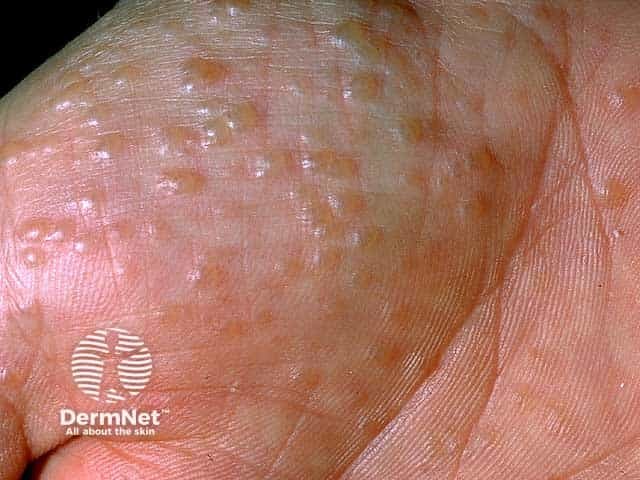
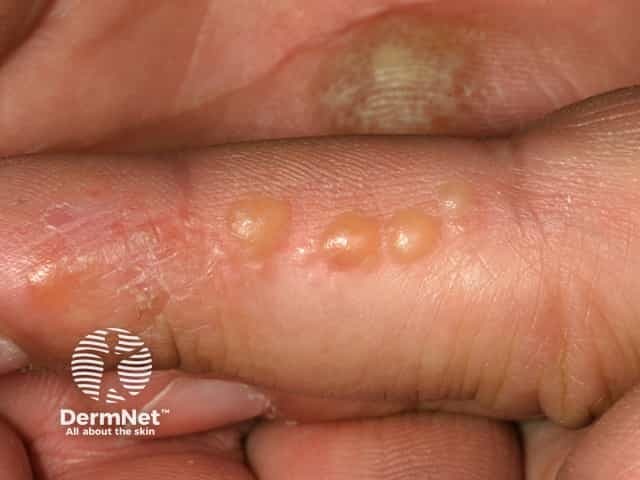
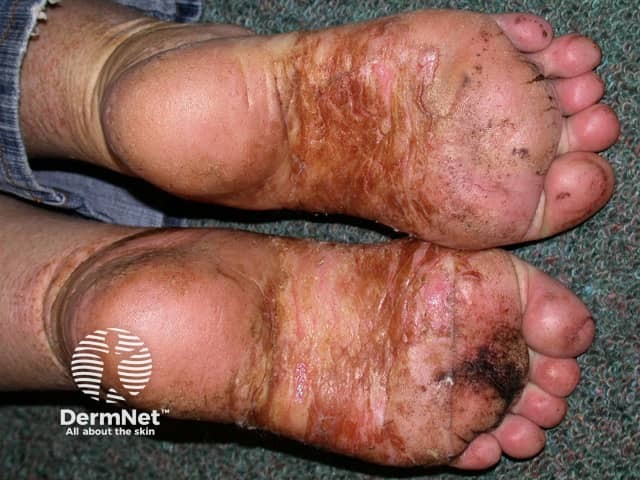
The exact prevalence of dyshidrotic eczema (pompholyx) is not known. Approximately 20% of patients assessed in a patch test clinic for hand dermatitis had dyshidrotic eczema (pompholyx). Occurrence appears not to correlate with age or gender.
The cause of dyshidrotic eczema (pompholyx) is not known.
It is not related to occlusion of sweat glands as was first thought when the disease was recognised over 100 years ago, but there are some factors associated with the disorder, including:
Dyshidrotic eczema (pompholyx) is a chronic, recurrent condition and appears as small, deep-seated, fluid-filled blisters (vesicles) on the sides of the fingers, hands, and feet.
Vesicles can also occur in other types of hand dermatitis.
Dyshidrotic eczema (pompholyx) is described as ‘tapioca-like’ in darker skin types, emphasising the greater colour contrast of the vesicles compared to less pigmented skin.
Dyshidrotic eczema (pompholyx) can lead to:
It is a clinical diagnosis as the history and clinical appearances are typical when other causes are excluded.
Differential diagnosis includes the following skin conditions:
The disorder can be chronic and cyclic. Short-term or long-term second-line treatment may be needed depending on the behaviour of the disease. However, for many the disorder settles in time and treatments can be withdrawn.