Introduction
Demographics
Causes
Clinical features
Variation in skin types
Complications
Differential diagnoses
Diagnosis
Treatment
Prevention
Outcome
Sunburn is an acute inflammatory skin reaction caused by excessive exposure to ultraviolet radiation (UVR) from the sun or artificial sources eg, tanning beds, ultraviolet phototherapy, and welding arcs.

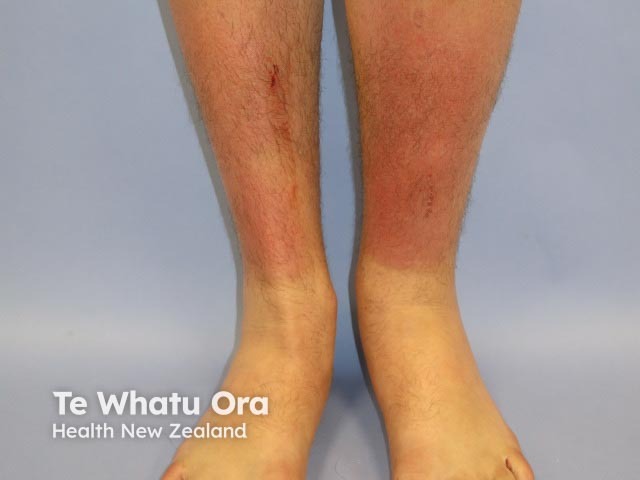

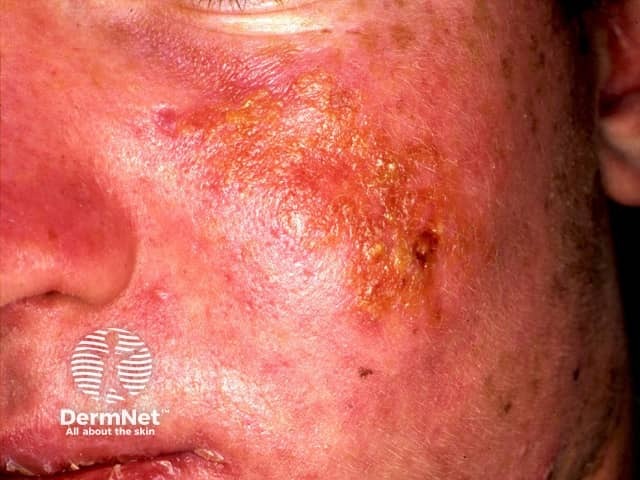

Sunburn is common and can affect anyone, but it occurs more frequently in adolescents and young adults.
Certain skin types (also called phototypes) are more susceptible to sunburn. As with skin colour, skin sensitivity to UVR is primarily determined by the amount and type of melanin it produces. Eumelanin, a black-brown melanin pigment, provides strong photoprotection by dissipating 99.9% of incoming UV energy into heat.
The level of solar UVR, and consequently the risk of sunburn, is influenced by several factors:
For more information, see: Ultraviolet index
Several behaviours and conditions have been identified as risk factors for sunburn:
Retinoids (topical or oral) and topical alpha hydroxy acids thin the stratum corneum, lowering the threshold for sun damage and increasing the risk of sunburn.
Sunburn results from skin damage induced by ultraviolet (UV) radiation, the portion of the electromagnetic spectrum with wavelengths ranging from 100 to 400 nanometres. The UV spectrum is further categorised by wavelength into three categories:
Solar UVA and UVB radiation are the primary contributors to sunburn:
Solar UVC radiation is fully absorbed by the atmosphere and therefore does not pose a risk for sunburn under natural conditions. However, UVC exposure from artificial sources (eg, welding torches, germicidal lamps, lasers) can induce severe sunburn in the superficial layer of the skin.
Although the exact mechanisms behind sunburn are not fully understood, it is widely believed that UV-induced DNA damage triggers the release of inflammatory mediators by keratinocytes, leading to the erythema and oedema characteristic of sunburn.
Inflammatory mediators implicated in sunburn include:
UVB and UVC radiation can directly damage DNA. By contrast, UVA radiation primarily causes indirect DNA damage by generating reactive oxygen species (ROS).
At higher doses of UVR, DNA damage becomes irreversible, triggering keratinocytes to undergo apoptosis (referred to as ‘sunburn cells’).
Mild to moderate sunburn:
Severe sunburn:
Erythema typically becomes apparent 2 to 6 hours after exposure, peaks at 12 to 24 hours, and resolves over 3 to 7 days. Blisters usually heal within 7 to 10 days.
Around 4 to 7 days post-exposure, the skin may start to peel (desquamation) and shed.
Epidermal changes:
Dermal changes:
Erythema may be less evident in individuals with darker skin tones.
Exogenous photodermatoses (cause exaggerated sunburn-like reactions)
Primary photodermatoses
Photoexacerbated dermatoses
Congenital photosensitivity disorders
For more information, see: photosensitivity.
Sunburn is primarily a clinical diagnosis based on the presence of painful erythema following exposure to the sun or other sources of UV radiation.
Phototesting to determine photosensitivity can be considered for patients who sunburn or have adverse skin reactions after minimal UVR exposure.
Sunburn is a self-limiting condition that is treated symptomatically:
Severe cases may require hospitalisation for fluid resuscitation, pain management, and wound care.
Although commonly used in clinical practice, the efficacy of topical steroids in ameliorating sunburn is controversial:
Sunburn can be effectively prevented through sun protection methods:
The more protective measures implemented, the greater the degree of photoprotection.
Sunburn typically resolves within a few days to weeks. Most sunburns can be self-managed at home with conservative treatment. The primary health risks associated with sunburn are due to an increased risk of skin cancers such as melanoma, basal cell carcinoma, and squamous cell carcinoma.