Amyloidosis
What is amyloidosis?
Amyloidosis is the term used for a group of diseases where one or more body organs accumulate various insoluble proteins (amyloid) in amounts to cause dysfunction of the organ system. Organs often affected include the heart, kidney, gastrointestinal tract, nervous system and skin. Amyloidosis of the skin is called cutaneous amyloidosis. In this condition, amyloid or amyloid-like proteins are deposited in the dermis layer of skin.
Types of amyloidosis
There are three major types of amyloidosis:
Primary amyloidosis
This disorder of protein metabolism originates in the bone marrow and is occasionally associated with multiple myeloma. It is sometimes also referred to as amyloid L chain type (AL) amyloidosis.
Primary systemic amyloidosis affects the heart, kidneys, liver, gastrointestinal tract and central nervous system. Skin involvement occurs in about 30-40% of patients.
Amyloidosis confined to the skin is called primary localised cutaneous amyloidosis. Several different types of primary localised cutaneous amyloidosis exist. These include lichen amyloidosis, macular amyloidosis and nodular primary localised cutaneous amyloidosis.
Secondary systemic amyloidosis
This occurs as a complication of many chronic inflammatory diseases such as rheumatoid arthritis and osteomyelitis.
It is also known as amyloid A (AA) amyloidosis and is the most common form of systemic amyloidosis worldwide.
The kidney, liver and spleen are the organs are most affected in secondary systemic amyloidosis. Skin involvement is rarely a feature of the disease.
Familial (hereditary) amyloidosis
This is a rare form of amyloidosis that is inherited and most commonly affects the kidneys. It is due to a mutated gene on chromosome 5.
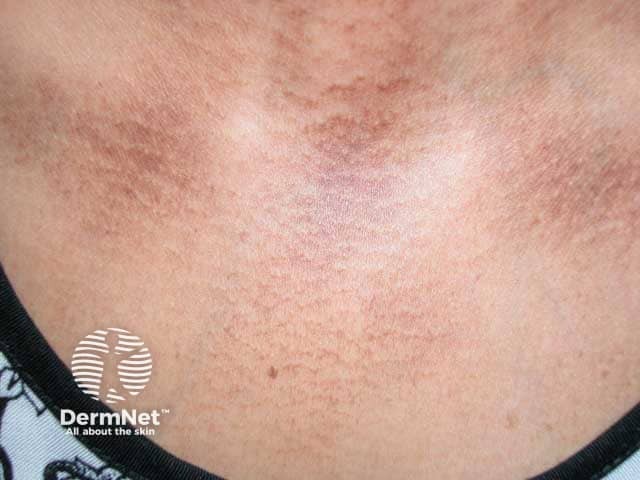
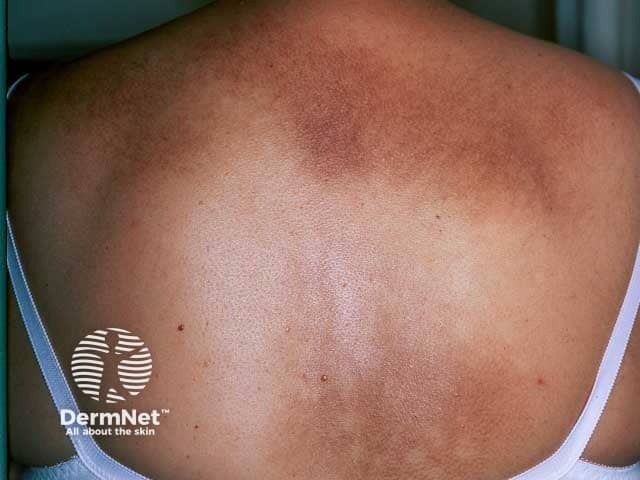
Macular amyloid |
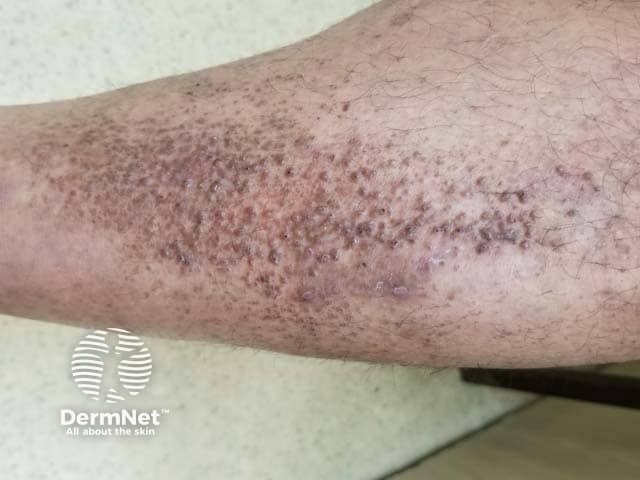
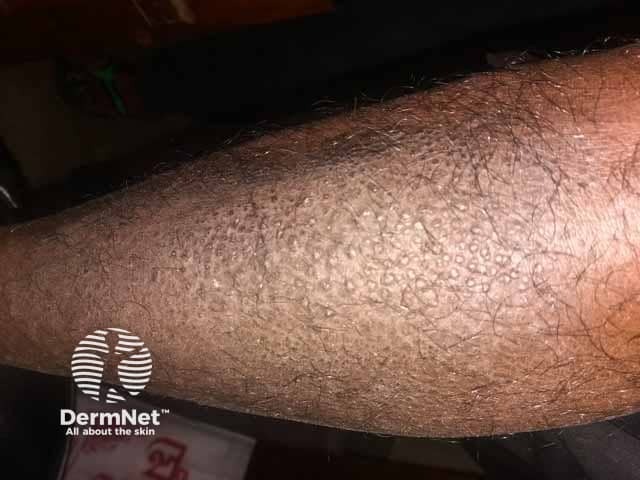
Lichen amyloid |
Nodular amyloid |
Hereditary amyloid |
Purpura Systemic amyloid |
Purpura
Systemic amyloid |
Macroglossia Systemic amyloid |
Clinical features of primary amyloidosis
The signs and symptoms of primary systemic amyloidosis are generally non-specific and include:
- Fatigue
- Weight-loss
- Oedema
- Shortness of breath
- Light headedness
- Numbness, tingling sensation
- Hoarseness
These may precede the diagnosis by up to two years. However, when they present together with the following specific symptoms, systemic amyloidosis should be considered a possible diagnosis.
- Carpal tunnel syndrome: disturbance of median nerve function in the wrist as the nerve passes through the carpal tunnel.
-
Skin lesions
- The most common skin findings are petechiae (small red blood spots) and ecchymoses (small, flat blood spots that are round or irregular shape and bluish/purplish in colour).
- Waxy papules, nodules or plaques may be found around the eyelids, neck, groin and anogenital area.
- Blood-filled blisters may form for example on pinching the skin.
- The nails may be crumbly and brittle.
- Patches of hair loss may arise.
- Macroglossia: this refers to an enlarged and firm tongue covered in blood spots, plaques and blisters.
- Oedema (tissue swelling) develops as a result of heart failure or nephrotic syndrome (kidney disease).
- Hepatomegaly (enlarged liver).
Distinctive clinical features are found for each type of primary localised cutaneous amyloidosis.
Lichen amyloidosis
- This is the most common form of primary localised cutaneous amyloidosis.
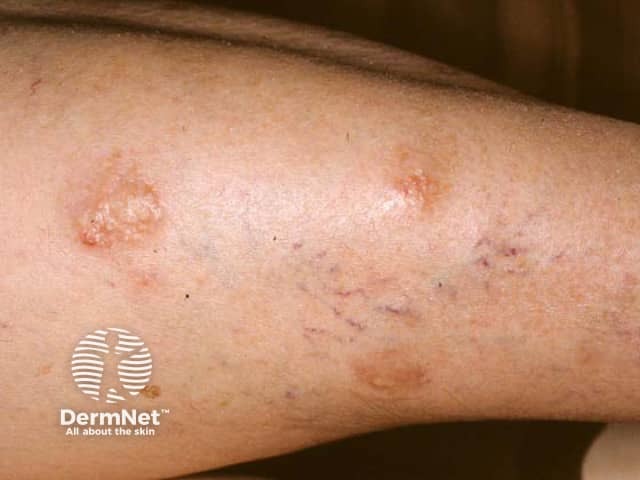
- It presents as an intensely itchy rash on the shins, thighs, feet, and forearms.
- Lesions consist of multiple raised spots (papules) that are scaly and red/brown in colour.
- Papules may coalesce into thickened plaques.
- It appears to be more common in people of Chinese descent and in males.
- It most often occurs between 50-60 years of age.
- It may be a variant of lichen simplex.
Macular amyloidosis
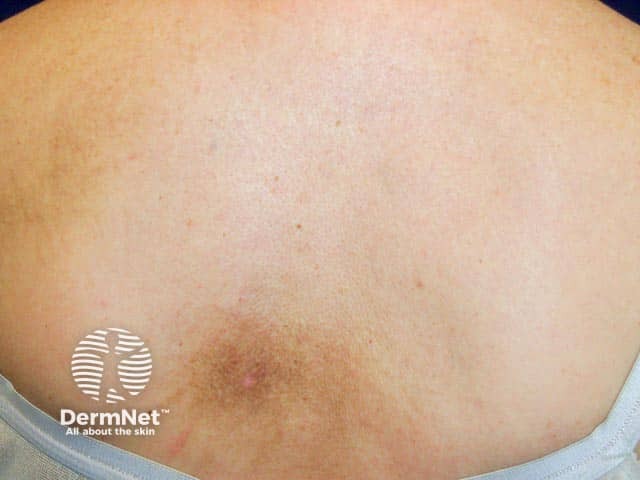
- In this case lesions appear as flat dusky-brown or greyish coloured spots that may coalesce to form patches of darkened skin.
- The degree of itchiness varies from mild to severe.
- Lesions are usually distributed symmetrically over the upper back between the shoulder blades, on the chest and sometimes on the arms.
- It appears to be more common in Asians, South Americans and Middle Easterners.
- It usually presents in early adult life and appears to affect women more frequently than men.
Nodular primary localised cutaneous amyloidosis
- This is the rarest form of primary localised cutaneous amyloidosis.
- Single or multiple firm nodules or plaques may occur on the trunk, limbs, extremities, face, and genitals.
- It is usually symptomless and patients seek medical attention for their appearance.
- Nodules may be a few millimetres to a few centimetres in size and may be pinkish brown to red in colour.
- Lesions tend not to ulcerate but some may crack or split, particularly those on the soles of the feet.
What is the treatment?
There is no specific treatment for primary systemic amyloidosis. Treatment is directed at maintaining the function of affected organs. For example kidney failure can be treated with dialysis and congestive heart failure with diuretics. Some treatments that have been tried with limited success include chemotherapy with melphalan and prednisone, and colchicine to inhibit amyloid deposition. Bone marrow ablation and transplantation is an experimental therapy. Most patients die within 1-2 years of diagnosis of primary systemic amyloidosis from heart and/or kidney failure.
The treatment of lichen and macular amyloidosis is focused on relieving itch. Sedating antihistamines can be moderately effective. Topical and intralesional steroids may provide some relief if used with other treatments. Other treatments tried include topical dimethyl sulfoxide (DMSO) and phototherapy (UVB) or PUVA).
Surgical treatment to remove amyloid deposits includes laser vaporization, dermabrasion, and excision of individual lesions. However, in most cases lesions recur.
The main aim of treatment of nodular primary localised cutaneous amyloidosis is to improve the appearance. Several methods are used and include antibiotics, topical and intralesional corticosteroids, cryotherapy, dermabrasion, shaving, curettage and electrodesiccation, carbon dioxide laser, and pulsed dye laser.
Related information
References:
- OMIM – Online Mendelian Inheritance in Man (search term Amyloidosis)
On DermNet NZ:
Other websites:
- emedicine dermatology
- Amyloidosis Australia Inc
- Amyloidosis Support Groups Inc.
Books:
See the DermNet NZ bookstore